Immediate Geopolitical Fallout: Israel-Iran Conflict Escalation
This analysis will explore the immediate geopolitical consequences of an Israeli attack on Iran, focusing on regional stability and potential for escalation. It will consider the roles of alliances, various conflict modalities, and major power involvement in the coming days and weeks.
Five-Lens Analysis
Synthesis & Key Insights
Alright class, Professor Jiang here. Let's synthesize the immediate geopolitical consequences of an Israeli strike on Iran, as of February 28, 2026, through our integrated five-lens framework. What we're witnessing is not merely a military action, but a profound shockwave through a highly interconnected, historically burdened, and psychologically charged system.
From the Game Theory Lens, this is a classic escalation game. Israel's 'limited strike' is an opening move, but its effectiveness hinges on Iran's response. The immediate incentive for Iran is calibrated retaliation to maintain deterrence and regime credibility, avoiding an existential war it cannot win. The US, caught in the middle, will play a complex game of deterrence, diplomacy, and de-escalation, aiming to prevent a regional conflagration while upholding its commitment to Israel. Russia will opportunistically exploit the distraction, while China will prioritize stability for its economic interests. The greatest danger is the commitment problem: can either side credibly commit to restraint once the first shot is fired? The game is inherently negative-sum if escalation occurs.
Our Elite Dynamics Lens reveals that this strike is a boon for hardliners on both sides. In Israel, it consolidates the power of the security establishment, validating their pre-emptive doctrine and creating a 'rally 'round the flag' effect, temporarily silencing opposition. For Iran, particularly the IRGC and hardline clerics, it's a gift: it validates their narrative of external threat, justifies further militarization, and provides a pretext to brutally suppress internal dissent, bolstering their legitimacy. US elites will be fractured, with hawks pushing for stronger action and the administration scrambling to manage the crisis without direct entanglement. Russian and Chinese elites will benefit from US distraction and potential energy market volatility. The social contract in both Israel and Iran will be temporarily strengthened by national unity, but severely tested if the conflict spirals out of control.
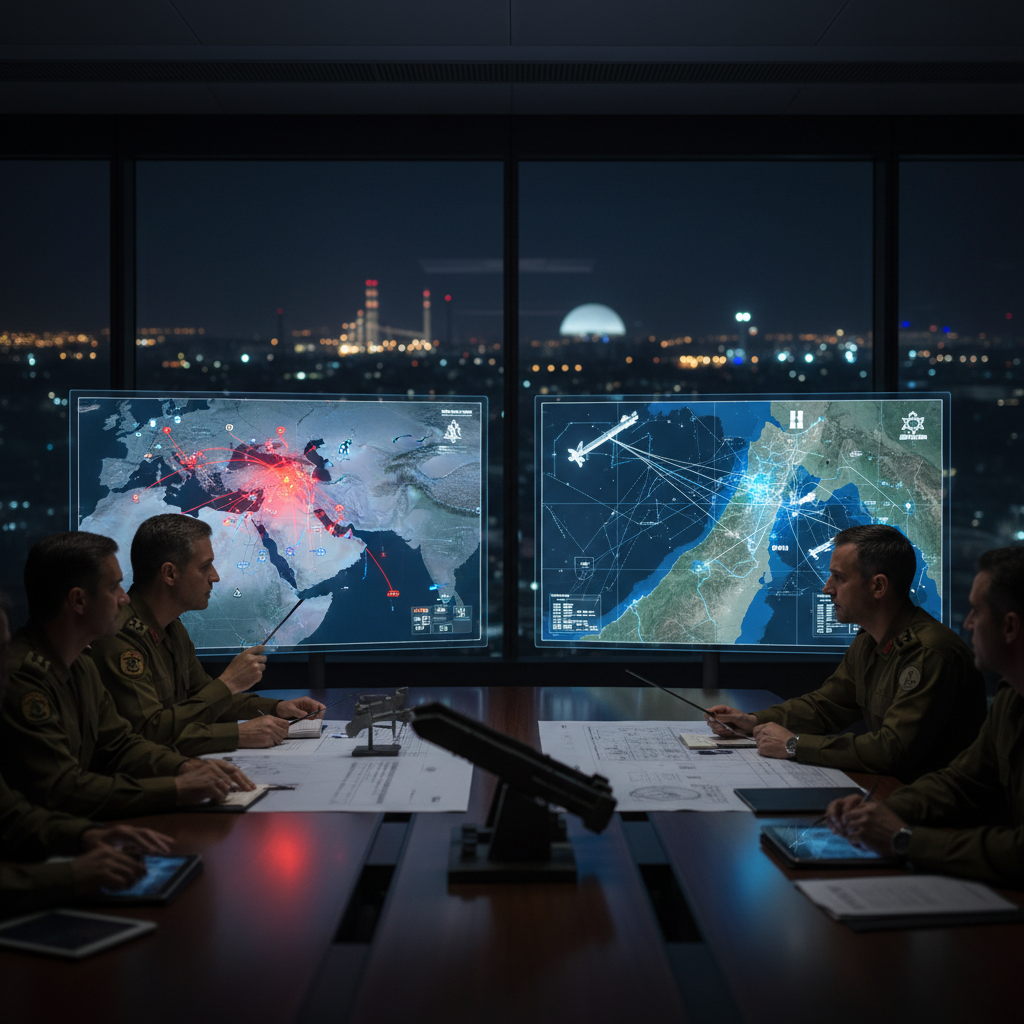
The Systems & Complexity Lens paints a grim picture of extreme fragility. The Middle East is a dense web of interconnected geopolitical, energy, financial, and information systems. An Israeli strike acts as a massive perturbation, activating powerful positive (escalatory) feedback loops. The action-reaction cycle, economic shock-geopolitical instability, and information warfare spirals will rapidly accelerate events. Tipping points include direct Iranian retaliation on Israeli soil, full-scale Hezbollah activation, or attempted closure of the Strait of Hormuz. The system's low resilience, high interdependency, and lack of trust mean cascading effects – global energy crisis, regional refugee crisis, global trade disruption, and increased major power tensions – are highly probable. The 'perfect storm' theory suggests that pre-existing stressors (climate, demographics, internal instability) make this system ripe for collapse.
Through the Historical Pattern Lens, we see echoes of the 'limited strike, unlimited repercussions' cycle, akin to Sarajevo, where a single act ignites a broader conflict. The 'proxy war escalation' cycle, reminiscent of the Great Game, ensures Iran's Axis of Resistance will activate, drawing in regional actors and potentially major powers. The 'Great Power Intervention & Balancing Act' will see the US, Russia, and China scrambling to manage or exploit the crisis, with high risks of miscalculation. Finally, the 'economic shock & resource scramble' cycle, like past oil crises, guarantees immediate global economic fallout. The 'narrative warfare & dehumanization' cycle will be amplified by advanced AI, making de-escalation even harder. History warns us that once direct action is taken in such a volatile region, control is rapidly lost.
Finally, the Psychological & Cultural Lens highlights the primal drivers. Israeli decision-makers are motivated by deep existential insecurity and a 'never again' mentality, coupled with domestic political survival. Iranian leaders are driven by revolutionary ideology, profound honor-shame dynamics demanding vengeance, and a need to maintain their 'resistance' narrative. Failure to retaliate would be an unbearable loss of face. The US is caught in a psychological dilemma between alliance commitment and de-escalation. Russia seeks to exploit the instability. The clash between honor-shame cultures (Iran, its proxies) and guilt-innocence frameworks (US, Europe) will lead to significant misunderstandings and further fuel escalation. The immediate need to 'save face' for Iran is paramount, making some form of retaliation almost inevitable.
In synthesis: An Israeli strike on Iran, even if initially limited, is a highly destabilizing event that will immediately trigger a complex, multi-domain, and likely escalatory response. The combined weight of strategic incentives for retaliation, elite consolidation around conflict, systemic fragility, historical precedents for uncontrolled escalation, and deep-seated psychological and cultural imperatives for vengeance, makes a contained outcome extremely difficult. The probability of a rapid, multi-front regional escalation, accompanied by severe global economic shock and intense narrative warfare, is alarmingly high. The 'rational actor' assumption is severely challenged by the emotional and cultural drivers at play. The world is now on the precipice of a regional war with global consequences.
Probabilistic Scenarios
Days to 2-3 Weeks
This scenario posits that both Israel and Iran, despite initial actions, will ultimately seek to avoid an all-out regional war due to the catastrophic mutual costs. Iran will execute a calibrated response to save face and re-establish deterrence, while the US will exert immense diplomatic and military pressure to de-escalate. The conflict will largely remain below the threshold of direct state-on-state conventional warfare, but regional tensions will remain extraordinarily high.
Key Triggers:
- Iran's leadership, following initial retaliation, receives clear back-channel messages from the US and/or Russia emphasizing severe consequences for further escalation.
- Initial Iranian retaliation is carefully designed to avoid mass casualties or critical infrastructure damage in Israel, allowing Israel to claim deterrence and avoid further immediate counter-escalation.
- Global economic shock (e.g., oil prices spiking over $150/barrel) creates strong international pressure for de-escalation from major powers like China and European Union.
Expected Outcomes:
- Iran launches limited, deniable missile/drone attacks on Israeli military targets or US assets in the region, or activates its proxies (Hezbollah, Iraqi militias, Houthis) for significant but not overwhelming attacks.
- Intense cyber warfare exchanges between Israel and Iran, targeting critical infrastructure but avoiding total collapse.
- US deploys additional military assets to the region (e.g., another carrier strike group, advanced air defense systems) and engages in a diplomatic blitz to de-escalate.
- Global oil prices spike temporarily (e.g., $120-$150/barrel) but stabilize as de-escalation efforts take hold.
- Increased internal repression in Iran as the regime uses the external threat to consolidate power and suppress dissent.
- Fragile, tense 'new normal' in the region, with heightened security alerts and a constant risk of renewed flare-ups.
Weeks to 2-3 Months
In this scenario, Iran's honor-shame cultural imperative for a robust response, combined with Israeli hardline resolve, leads to a significant and sustained regional proxy war. While direct state-on-state conventional war is still largely avoided, the conflict expands across multiple fronts involving Iran's 'Axis of Resistance' and potentially drawing in US forces in defensive or limited retaliatory roles. The region becomes a multi-front battlefield.
Key Triggers:
- Iranian leadership, under internal pressure, orders a more substantial retaliation than anticipated, causing significant damage or casualties in Israel.
- Hezbollah launches a major, sustained rocket/missile barrage into northern Israel, triggering a significant Israeli counter-response into Lebanon.
- Iranian proxies (e.g., Houthis, Iraqi militias) successfully attack US assets or personnel, forcing a direct US military response against those proxy groups.
- Miscalculation or misinterpretation of signals by either side, or an autonomous AI-driven defensive system, leads to an unintended escalation of force.
- Cyberattacks escalate to cause widespread, prolonged disruption of critical infrastructure in either Israel or Iran, perceived as an act of war.
Expected Outcomes:
- Full-scale activation of Hezbollah against Israel, leading to widespread destruction in Lebanon and northern Israel, and potentially an Israeli ground invasion.
- Intensified attacks by Iranian-backed militias against US forces and interests in Iraq and Syria, leading to direct US retaliatory strikes against those groups.
- Houthis significantly escalate attacks on Red Sea shipping, potentially attempting to close the Bab el-Mandeb Strait, leading to international naval intervention.
- Global oil prices surge and remain high (e.g., $150-$200+/barrel), triggering a severe global economic downturn and supply chain disruptions.
- Major powers (US, Russia, China) engage in intense diplomatic maneuvering and military posturing, with increased risk of direct confrontation.
- Significant internal political instability in affected regional states (e.g., Lebanon, Iraq) due to the conflict and refugee flows.
Days to Weeks
This is the 'perfect storm' scenario, where a series of miscalculations, overwhelming psychological drivers, and systemic fragility lead to a complete breakdown of deterrence. The conflict rapidly escalates into direct, conventional state-on-state warfare between Israel and Iran, inevitably drawing in the United States and potentially other regional and global powers. The consequences are catastrophic for the Middle East and trigger a severe global crisis.
Key Triggers:
- Iran launches a direct, overwhelming missile/drone attack from its territory on Israeli cities or critical infrastructure, causing mass casualties.
- Israel responds with a disproportionate counter-strike targeting Iranian military command-and-control, missile sites, or even leadership targets.
- Iran attempts to close the Strait of Hormuz, triggering immediate and forceful US military intervention.
- US forces are directly and severely attacked by Iran or its proxies, forcing a full-scale US declaration of war or comprehensive military response.
- Nuclear facilities (Israeli or Iranian) are directly targeted or severely damaged, leading to fears of proliferation or environmental catastrophe.
- A major power (e.g., Russia) provides overt and significant military support to Iran, challenging US dominance and escalating the conflict to a higher level.
Expected Outcomes:
- Direct, conventional military conflict between Israel, Iran, and potentially the US, involving air, naval, and ground forces across the region.
- Massive destruction of infrastructure, widespread civilian casualties, and a humanitarian crisis of unprecedented scale across the Middle East.
- Global oil prices skyrocket (e.g., $200-$300+/barrel), leading to a severe global recession, financial market collapse, and widespread energy shortages.
- Global supply chains completely collapse, leading to widespread shortages of goods and essential resources.
- Escalation of cyber warfare to a global scale, impacting critical infrastructure worldwide, even for non-belligerent nations.
- Significant geopolitical realignment, with increased tensions between major global powers and potential for further conflicts elsewhere.
- Long-term destabilization of the Middle East, potentially leading to new state formations or prolonged internal conflicts.
Sign in to join the discussion
Sign InNo comments yet. Be the first to share your thoughts!
Related Analyses
AI-powered recommendationsThis analysis will assess the immediate likelihood of a military conflict involving Iran, the USA, and Israel within the next few weeks. It will calculate a percentage probability and outline the primary geopolitical, military, and economic risks associated with such an escalation.
This analysis will assess the probabilities, triggers, and likely scenarios for direct military confrontation or significant proxy warfare escalation involving Iran, the United States, and Israel. It will consider their strategic interests, regional alliances, and economic vulnerabilities amidst current geopolitical tensions and nuclear negotiations.
This analysis will assess the probability of a direct military conflict between Iran and the United States within the next 1-3 years, considering escalating regional tensions, maritime incidents, and Iran's nuclear program. It will identify potential triggers, key geopolitical actors involved, and the likely economic and strategic repercussions for the global order.
This analysis will assess the current geopolitical landscape and recent events to determine the immediate likelihood of a direct military conflict involving Iran, the USA, and Israel. It will consider key indicators of escalation or de-escalation over the next few weeks.