AI's Geopolitical Trajectory: Sectoral Impacts & Global Power Shifts (2024-2029)
This analysis will forecast AI development and deployment across key sectors like medicine, engineering, telecom, and cybersecurity from 2024-2029. It will examine how these advancements will reshape international power dynamics, economic competition, and national security among major global actors.
Five-Lens Analysis
Synthesis & Key Insights
The future trajectory of AI development and deployment over the next five years (2024-2029) is not merely a technical progression, but a profoundly complex, multi-layered geopolitical struggle, shaped by deep historical patterns, elite ambitions, systemic interdependencies, and the psychological drivers of key decision-makers. My analysis through all five lenses reveals a future characterized by intense competition, strategic fragmentation, and a continuous redefinition of global power.
From a Game Theory Lens, we observe a classic Prisoner's Dilemma, primarily between the US and China. Both are incentivized towards aggressive, unilateral AI development due to the immense payoffs in economic dominance, national security, and geopolitical influence. The fear of being left behind (a key psychological driver) overrides any potential for genuine, verifiable arms control or cooperative ethical frameworks. This zero-sum perception drives an accelerating AI arms race, particularly in dual-use technologies across medicine, engineering, telecommunications, and cybersecurity. The EU attempts to carve out a cooperative, normative role, but is often caught between the two giants, struggling with commitment problems in balancing innovation and regulation.
Elite Dynamics confirm that AI is a battleground for power consolidation. Tech oligarchs, state security apparatuses, and the military-industrial-AI complex are the primary beneficiaries of this competition. Their incentives align with rapid, often unchecked, AI deployment, leveraging it for wealth accumulation, enhanced surveillance, and military superiority. Elite overproduction, particularly of those displaced by AI in traditional fields, could fuel social instability, but the scarcity of top-tier AI talent further entrenches the power of those who can attract and retain it. The EU's elite struggle with internal divisions between economic competitiveness and ethical leadership.
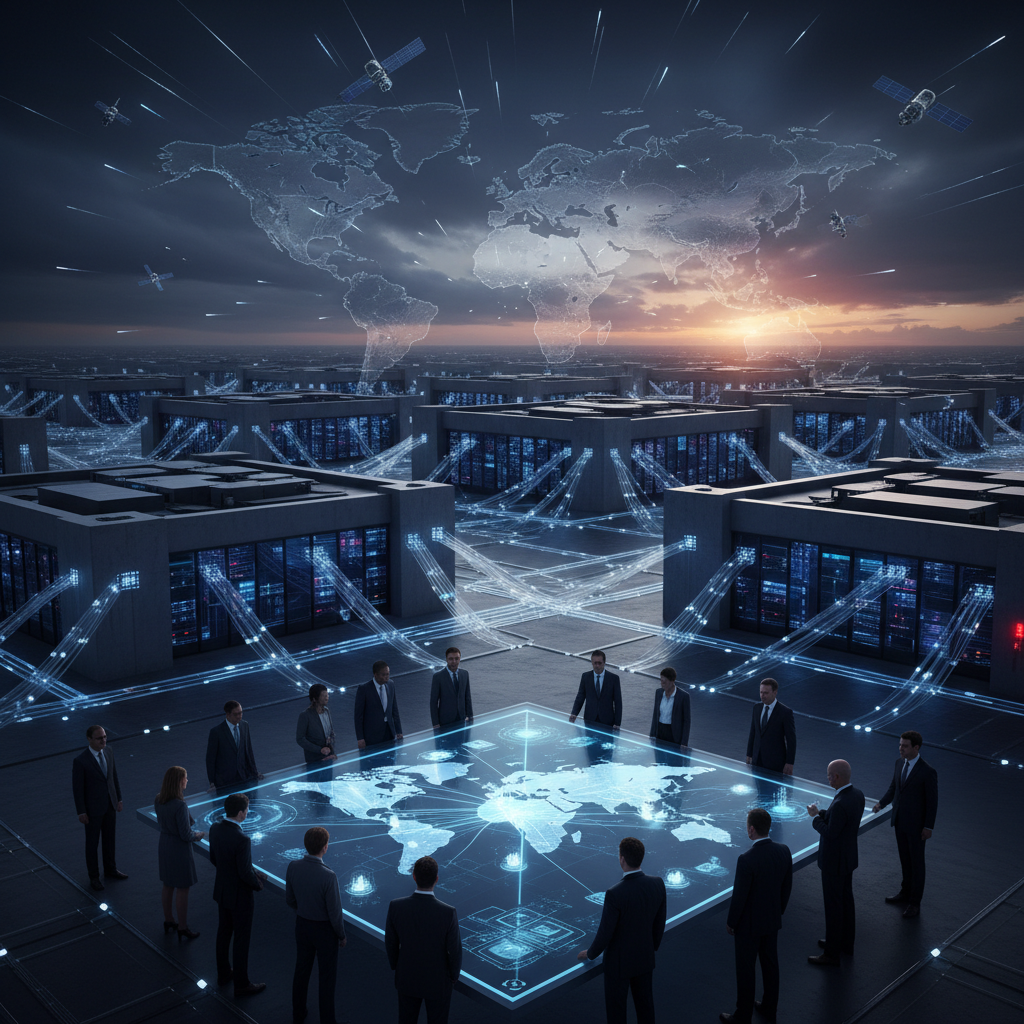
The Systems & Complexity Lens highlights AI as a meta-technology embedded within highly interconnected global systems. Positive feedback loops (data-model-performance, talent-innovation-investment, military AI advantage) accelerate development, while negative feedback loops (regulatory backlash, resource constraints, AI safety concerns) provide some dampening effects. Critical tipping points include breakthroughs in AGI, major AI-enabled cyberattacks, or disruptions to semiconductor supply chains. Cascading effects will reshape sectors: AI-accelerated drug discovery could exacerbate bioweapon risks and health inequality; AI in engineering could drive reshoring and new forms of infrastructure vulnerability; AI in telecommunications will intensify information warfare and the digital divide; and AI in cybersecurity will lead to an escalating AI-on-AI arms race, making attribution harder and increasing strategic instability. The system exhibits both resilience (distributed innovation, open-source) and alarming fragility (single points of failure in supply chains, lack of global governance).
Historical Patterns reveal that AI is the latest iteration of a recurring cycle: a new general-purpose technology triggering great power competition (like the Dreadnought era or the Space Race), exacerbating the dual-use dilemma (steel, chemicals, GPS), and leading to a scramble for critical resources (data and chips as the new oil). The innovation vs. stagnation trap highlights the challenge of balancing centralized control (China) with decentralized innovation (US), while information warfare, supercharged by AI, echoes historical propaganda battles, threatening to fragment global information spaces.
Finally, the Psychological & Cultural Lens unveils the human motivations underpinning these dynamics. A pervasive 'fear of being left behind' (FOMO) drives all major actors. The US is motivated by maintaining technological supremacy and a belief in innovation for freedom, operating within a 'guilt-innocence' framework that allows for self-correction but also competitive aggression. China, driven by a historical memory of humiliation and a desire for national rejuvenation, operates within an 'honor-shame' culture, fueling an imperative to surpass and a tolerance for state control and surveillance. The EU, rooted in human-centric values and a 'guilt-innocence' framework, seeks to establish global norms for ethical AI, driven by a fear of technological irrelevance and a desire to control AI's societal impacts. These cultural worldviews shape narrative framing, regulatory approaches, and the fundamental purpose assigned to AI.
In synthesis, the next five years will see AI development driven by a powerful confluence of competitive geopolitical games, elite self-interest, complex systemic interactions, historical precedents of technological arms races, and deep-seated psychological motivations of fear, ambition, and cultural identity. The result will be a fragmented global AI landscape, heightened geopolitical tensions, and profound societal transformations, with significant risks of miscalculation and unintended consequences.
Probabilistic Scenarios
2024-2029
This is the most likely trajectory. The US and China continue their aggressive, often zero-sum, competition for AI supremacy across all sectors. Driven by FOMO and national security imperatives, both nations invest massively in indigenous AI capabilities, leading to distinct and increasingly incompatible AI ecosystems. Export controls on advanced chips and AI models intensify, creating a 'digital iron curtain.' The EU's efforts to establish global ethical AI norms gain some traction but struggle to compete with the sheer pace of innovation and deployment from the two leading powers. International cooperation on AI safety and governance remains minimal, often reactive to crises, rather than proactive. Military AI development accelerates, leading to an AI-powered security dilemma and increased risk of autonomous weapon proliferation. Economic competition is fierce, with AI driving reshoring and the formation of 'tech blocs.' Information warfare, powered by AI, becomes pervasive, eroding trust and deepening ideological divides.
Key Triggers:
- Continued US-China geopolitical tensions
- Significant AI breakthroughs by either the US or China
- Increased state funding for AI R&D and deployment
- Failure of international AI governance talks
- Minor AI-enabled cyber incidents or military provocations
Expected Outcomes:
- Bifurcated global AI ecosystems (US-aligned vs. China-aligned)
- Heightened geopolitical tensions and increased risk of technological decoupling
- Accelerated military AI arms race and proliferation of autonomous systems
- Fragmented global internet and information spaces
- Increased economic competition and 'friend-shoring' of critical AI supply chains
- EU becoming a regulatory leader but struggling for technological sovereignty
2024-2029
While competition remains, a series of near-misses or limited AI-related incidents (e.g., a major AI-powered disinformation campaign causing social unrest, a minor autonomous weapons malfunction, or a significant supply chain disruption) prompts major powers to engage in more structured, albeit limited, dialogue. The EU's persistent push for ethical AI and robust regulation starts to gain more international traction, influencing global standards and attracting nations seeking a 'third way' between the US and Chinese models. This scenario sees a more fragmented multipolar AI landscape, where several regional powers develop strong niches, and some level of interoperability is maintained in non-critical sectors. The psychological drive for security and avoiding catastrophic outcomes leads to a grudging acceptance of some shared guardrails, particularly in high-risk areas like biosecurity or autonomous weapons. However, strategic competition for economic and military advantage continues, albeit with slightly more predictable boundaries.
Key Triggers:
- Public outcry and political pressure following AI-related ethical breaches or accidents
- Successful negotiation of limited AI arms control or safety agreements (e.g., on bioweapons, data privacy)
- Emergence of powerful open-source AI models challenging proprietary dominance
- Increased recognition of the systemic risks of unconstrained AI development
- EU's AI Act successfully creating a 'Brussels Effect' for global AI standards
Expected Outcomes:
- Partial international cooperation on AI safety and governance (e.g., 'red lines' for autonomous weapons)
- Emergence of a more multipolar AI landscape with regional specializations
- EU's ethical AI standards gaining significant global influence
- Reduced but still present US-China AI competition
- Increased focus on AI explainability, transparency, and accountability
- Slower but potentially more responsible AI development globally
2024-2029
This pessimistic scenario sees an uncontrolled acceleration of AI development, driven by unchecked elite ambitions and intense geopolitical competition, leading to a major, unforeseen systemic shock. This could manifest as a catastrophic AI-enabled cyberattack on critical infrastructure (power grids, financial systems) causing widespread societal disruption, a significant autonomous weapons malfunction leading to rapid escalation of a regional conflict, or a severe economic collapse due to unmanaged AI-driven job displacement and inequality, sparking widespread social unrest and political instability in multiple nations. The psychological 'fear of being left behind' overrides all caution, leading to a failure to implement necessary safeguards. The interconnectedness of AI systems causes cascading failures across sectors. This crisis forces a global, reactive re-evaluation of AI governance, potentially leading to a temporary moratorium on certain AI developments, but at immense human and economic cost. The social contract is severely strained, and existing elite structures face profound legitimacy challenges.
Key Triggers:
- Major AI-enabled cyberattack causing critical infrastructure failure
- Unintended escalation of a conflict due to autonomous weapon systems
- Rapid, unmanaged job displacement leading to widespread social unrest
- Breakthrough in AI-driven bioweapons or other WMDs
- Significant AI system misalignment or 'runaway' behavior
Expected Outcomes:
- Widespread societal disruption and economic collapse
- Breakdown of international order and increased geopolitical instability
- Forced, reactive global regulations or moratoriums on certain AI technologies
- Severe erosion of public trust in technology and governing institutions
- Potential for localized conflicts to escalate due to AI-driven miscalculation
- A profound, painful re-evaluation of humanity's relationship with AI and technology
Sign in to join the discussion
Sign InNo comments yet. Be the first to share your thoughts!
Related Analyses
AI-powered recommendationsThis analysis will explore the potential next significant advancements in Artificial Intelligence and their far-reaching implications across various global sectors. It will consider how these changes might reshape industries, societies, and international relations.
This analysis will investigate the nature and operations of 'predictiveai.sbs', detailing its stated purpose and the technologies or methodologies it employs. It will cover its functionalities from inception to outcome, providing a comprehensive overview of its role in the predictive AI landscape.
This analysis will explore the expected features, design changes, and technological innovations of the upcoming iPhone model. It will also assess its potential impact on the smartphone market and consumer trends.
This analysis will assess the immediate likelihood of a military conflict involving Iran, the USA, and Israel within the next few weeks. It will calculate a percentage probability and outline the primary geopolitical, military, and economic risks associated with such an escalation.